

Arthroscopic Devices Market Worth US$ 8.6 Bn in 2026, CAGR 4.9% | Persistence Market Research
arthroscopic devices market
Arthroscopic devices market grows with rising minimally invasive surgeries, sports injuries, and advances in orthopedic imaging and surgical tools.
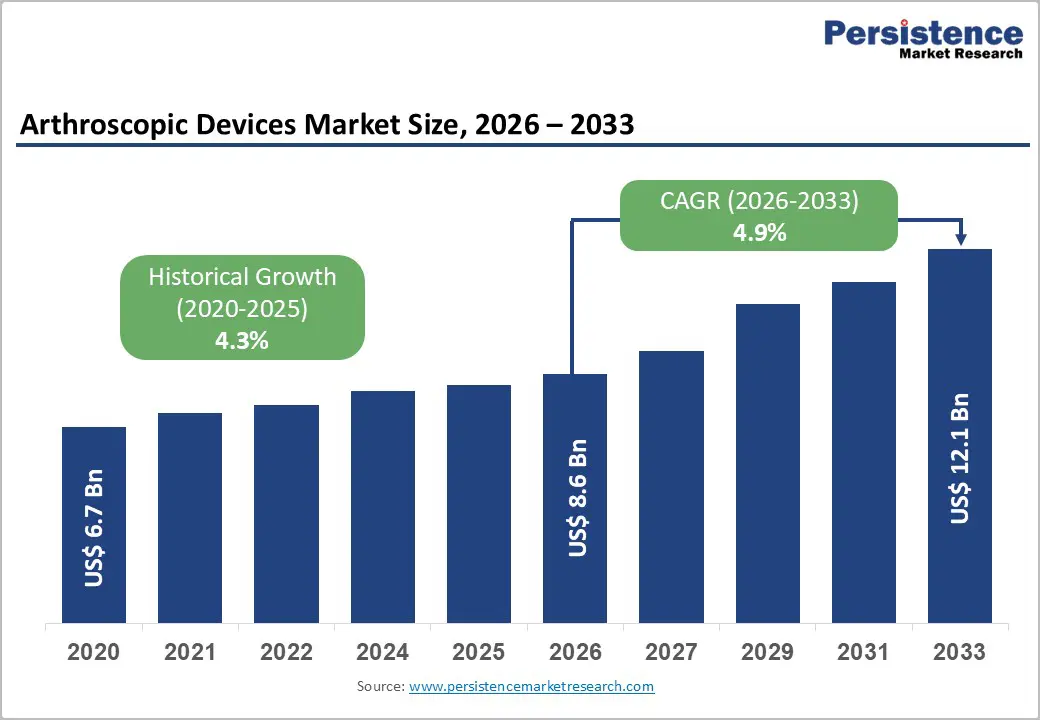
LONDON, UNITED KINGDOM, March 25, 2026 /EINPresswire.com/ -- The global arthroscopic devices market is projected to reach a value of US$ 8.6 billion in 2026 and expand to US$ 12.1 billion by 2033, registering a compound annual growth rate (CAGR) of 4.9% during the forecast period. This steady growth reflects the increasing adoption of minimally invasive orthopedic procedures and rising demand for advanced surgical technologies. Arthroscopy has become a preferred approach among surgeons due to its ability to deliver precise outcomes with reduced trauma, minimal scarring, and faster recovery times. Continuous innovation in imaging systems, surgical instruments, and implant materials is further strengthening market expansion.
Download Your Free Sample & Explore Key Insights: https://www.persistencemarketresearch.com/samples/18358
Market Dynamics
One of the primary drivers of the arthroscopic devices market is the growing geriatric population, which is more susceptible to musculoskeletal disorders such as osteoarthritis and degenerative joint diseases. As aging populations increase globally, the demand for joint repair and replacement procedures continues to rise. This trend significantly contributes to the growing need for arthroscopic interventions, particularly in knee and hip surgeries.
In addition, the rising incidence of sports-related injuries is playing a crucial role in boosting market demand. Increased participation in physical activities and sports has led to a higher frequency of ligament tears, meniscal injuries, and shoulder dislocations. Arthroscopy is widely used in treating such conditions because it enables faster rehabilitation and reduces hospital stays. As awareness of these benefits spreads, both patients and healthcare providers are opting for arthroscopic procedures over traditional open surgeries.
However, the market faces certain challenges. High costs associated with arthroscopic equipment, including advanced visualization systems and surgical tools, limit accessibility in low- and middle-income regions. Furthermore, the need for specialized training and skilled professionals poses an additional barrier. Many healthcare facilities lack adequately trained surgeons, which can restrict procedural adoption.
Another restraint is the presence of stringent regulatory requirements and quality standards. Product recalls due to manufacturing defects or sterility issues can negatively impact market growth. Maintaining consistent product quality and compliance with regulatory frameworks remains a critical concern for manufacturers.
Opportunities in Minimally Invasive Procedures
The increasing preference for minimally invasive procedures presents a major growth opportunity for the arthroscopic devices market. Patients are increasingly choosing arthroscopy due to benefits such as smaller incisions, reduced pain, and quicker return to daily activities. Healthcare systems are also promoting outpatient surgical models, which align well with arthroscopic techniques.
Technological advancements are further enhancing the effectiveness of these procedures. High-definition cameras, improved fluid management systems, and precision-guided instruments allow surgeons to perform complex interventions with greater accuracy. These innovations are expanding the application of arthroscopy across multiple joints, including the knee, shoulder, hip, and ankle.
Get Custom Insights Designed for Your Businecss: https://www.persistencemarketresearch.com/request-customization/18358
Category-wise Insights
In terms of product segmentation, arthroscopic implants hold a dominant share in the market. These implants are extensively used in procedures such as ligament reconstruction, rotator cuff repair, and meniscal fixation. Continuous improvements in implant design, including the development of bioabsorbable materials, are driving their adoption. These materials eliminate the need for removal surgeries and promote natural healing, making them highly attractive in modern orthopedic care.
From an end-user perspective, hospitals remain the largest segment due to their advanced infrastructure and ability to handle complex surgical cases. However, ambulatory surgical centers (ASCs) are emerging as the fastest-growing segment. These facilities offer cost-effective treatment options and support same-day discharge, making them increasingly popular among patients and payers.
Regional Insights
North America leads the global arthroscopic devices market, supported by advanced healthcare infrastructure, high procedure volumes, and strong reimbursement systems. The region’s widespread adoption of minimally invasive techniques and continuous technological innovation contribute to its dominant position.
Meanwhile, the Asia Pacific region is expected to witness the fastest growth during the forecast period. Factors such as improving healthcare infrastructure, rising awareness of advanced surgical options, and increasing prevalence of orthopedic conditions are driving regional expansion. Countries like China, India, and Japan are investing heavily in healthcare modernization, which is accelerating the adoption of arthroscopic technologies.
Competitive Landscape
The arthroscopic devices market is highly competitive, with several global and regional players focusing on innovation and strategic expansion. Companies are investing in research and development to introduce advanced products that enhance surgical efficiency and patient outcomes. Collaborations with hospitals and sports medicine centers are also common strategies to strengthen market presence.
In addition, manufacturers are expanding their production capabilities and entering emerging markets to tap into new growth opportunities. Continuous advancements in technology, combined with increasing demand for minimally invasive procedures, are expected to sustain long-term market growth.
Checkout Now & Download Complete Market Report: https://www.persistencemarketresearch.com/checkout/18358
Market Segmentation
Product
Arthroscopic Implants
Arthroscopies
Shoulder Implants
Arthroscopic Radio Frequency Devices
Arthroscopic Radio Frequency Systems
Other
End User
Hospitals
Ambulatory Surgical Centers
Orthopedic Clinics
Regions
North America
Europe
East Asia
South Asia & Oceania
Latin America
Middle East & Africa
Read Related Reports:
Umbilical Cord Blood Banking Market: Global umbilical cord blood banking market to grow from US$32.7 Bn in 2026 to US$63.2 Bn by 2033, registering a 9.2% CAGR driven by stem cell therapies.
Ayurvedic Medicine Market: The ayurvedic medicine market projected to grow from US$ 16.1 Bn in 2026 to US$ 28.4 Bn by 2033, registering a strong 8.4% CAGR during forecast period.
Persistence Market Research
Persistence Market Research Pvt Ltd
+1 646-878-6329
email us here
Visit us on social media:
LinkedIn
Instagram
Facebook
YouTube
X
Legal Disclaimer:
EIN Presswire provides this news content "as is" without warranty of any kind. We do not accept any responsibility or liability for the accuracy, content, images, videos, licenses, completeness, legality, or reliability of the information contained in this article. If you have any complaints or copyright issues related to this article, kindly contact the author above.
