

CAIO Connect Podcast: Host Sanjay Puri Explores AI Governance and Healthcare Transformation with Cigna’s Katya Andresen

CAIO Connect Podcast
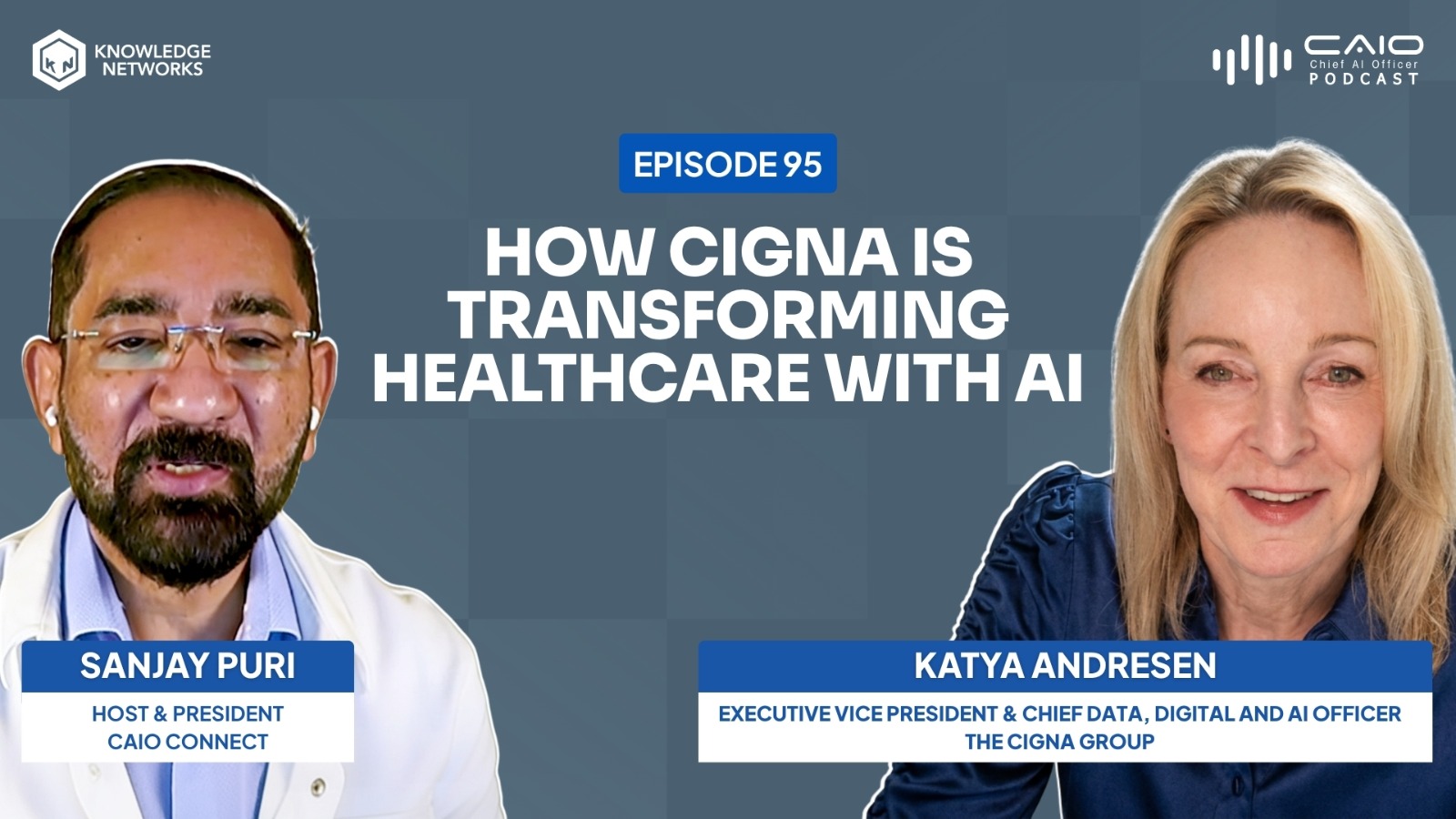
Katya Andresen, Chief Digital and Analytics Officer at The Cigna Group with Sanjay Puri, President of CAIO Connect
Katya Andresen tells CAIO Connect Podcast host Sanjay Puri how AI governance, human-centered leadership, and responsible innovation are transforming healthcare.
Andresen explained that her journalism background prepared her remarkably well for leading AI initiatives. Reporting in fast-moving, high-stakes environments taught her to separate signal from noise, validate information quickly, and make decisions under uncertainty—skills she now applies daily in the rapidly evolving AI landscape. She emphasized that AI leadership is less about technical expertise alone and more about curiosity, critical thinking, and asking the right questions. For young professionals concerned about AI-driven disruption, Andresen encouraged them to focus on uniquely human capabilities such as creativity, judgment, and problem-solving rather than fearing technological change.
At Cigna, AI adoption began long before the emergence of generative AI. The company had already established strong machine learning capabilities supported by rigorous governance frameworks, a necessity in the highly regulated healthcare industry. Andresen noted that the arrival of generative and agentic AI accelerated the organization's ambitions, enabling more sophisticated predictive models, personalized healthcare experiences, and operational efficiencies. However, she stressed that AI maturity should not be measured solely by technological sophistication but by how deeply AI is integrated into meaningful business decisions and patient outcomes.
A major theme of the discussion was AI governance. According to Andresen, governance should not be viewed as a constraint but as the foundation that enables organizations to innovate faster and more responsibly. Rather than treating governance as an afterthought, Cigna embeds legal, cybersecurity, compliance, and bias-testing teams directly into the development process. This approach ensures that accountability, transparency, and safety are incorporated from the beginning. She also highlighted that while agentic AI offers tremendous opportunities, healthcare organizations must maintain human oversight, particularly in areas involving clinical decisions and coverage determinations where human judgment remains essential.
The conversation also focused heavily on change management, which Andresen described as the most challenging aspect of AI transformation. She argued that organizations often fail when they introduce AI as a technology project rather than a new way of working. Success requires a clear sense of purpose, transparent communication from leadership, and cross-functional collaboration. Small multidisciplinary teams composed of operational experts, clinicians, engineers, and designers can accelerate innovation while building trust across departments. Visible successes, even on a small scale, help overcome skepticism and encourage broader adoption. Importantly, Andresen believes employees must experience AI’s benefits firsthand before they can fully embrace change.
Looking ahead, Andresen sees AI as a catalyst for fundamentally reimagining healthcare rather than simply automating existing processes. From intelligent voice agents in customer service to AI-powered care management tools that support nurses and clinicians, the technology has the potential to make healthcare more personalized, accessible, and efficient. Yet she cautioned against excessive hype, particularly around AI agents, noting that while their immediate impact may be overstated, their long-term influence is likely underestimated. Ultimately, she concluded that organizations that combine responsible governance, continuous experimentation, strong leadership, and a relentless focus on solving meaningful problems will be best positioned to realize AI’s transformative potential in healthcare.
Upasana Das
Knowledge Networks
email us here
Visit us on social media:
LinkedIn
Instagram
Facebook
YouTube
X
Legal Disclaimer:
EIN Presswire provides this news content "as is" without warranty of any kind. We do not accept any responsibility or liability for the accuracy, content, images, videos, licenses, completeness, legality, or reliability of the information contained in this article. If you have any complaints or copyright issues related to this article, kindly contact the author above.
