

CAR T-Cell Therapy Market Set to Reach US$24 Billion by 2032 at 25% CAGR | Persistence Market Research
CAR T-Cell Therapy Market
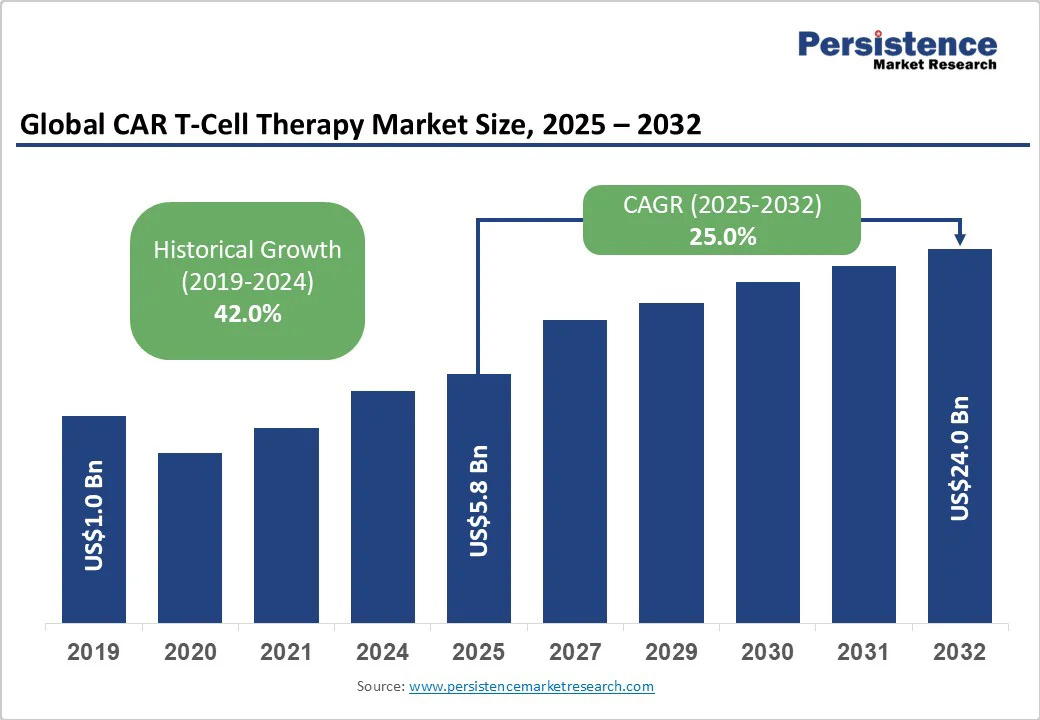
BRENFORD, LONDON, UNITED KINGDOM, July 1, 2026 /EINPresswire.com/ -- The CAR T-Cell Therapy Market has become one of the fastest-growing segments within the global oncology industry as healthcare providers increasingly adopt personalized immunotherapy solutions for treating complex cancers. Chimeric Antigen Receptor (CAR) T-cell therapy uses genetically engineered immune cells to recognize and eliminate cancer cells more effectively than many conventional treatment approaches. The growing preference for precision medicine, continuous advancements in gene engineering, and increasing investment in cell-based therapies are strengthening market expansion. According to Persistence Market Research, the global CAR T-cell therapy market is likely to be valued at US$5.8 Billion in 2025 and is projected to reach US$24 Billion by 2032, expanding at a remarkable CAGR of 25% during the forecast period from 2025 to 2032.
Get Your FREE Sample Report Instantly – Click Now : https://www.persistencemarketresearch.com/samples/28264
The market is benefiting from rising research activities, increasing regulatory support for innovative therapies, and expanding commercialization of advanced immunotherapies. Pharmaceutical companies continue investing in clinical trials to improve treatment effectiveness and broaden therapeutic applications beyond blood cancers. Hospitals and specialty cancer centers are enhancing their infrastructure to support CAR T-cell therapy administration and patient monitoring. Hematological malignancies continue to represent the leading application segment because of proven clinical outcomes and strong treatment success rates. North America remains the leading regional market owing to its advanced healthcare infrastructure, significant biotechnology investments, favorable reimbursement environment, and the presence of leading biotechnology and pharmaceutical companies actively developing innovative CAR T-cell therapies.
Key Highlights from the Report
➤ The global CAR T-cell therapy market is projected to grow from US$5.8 Billion in 2025 to US$24 Billion by 2032, registering a 25% CAGR.
➤ Rising adoption of personalized immunotherapy is accelerating demand across cancer treatment centers worldwide.
➤ Continuous advancements in gene engineering technologies are improving treatment precision and patient outcomes.
➤ Increasing regulatory approvals and expanding clinical trials are creating long-term growth opportunities.
➤ Hospitals and specialized oncology centers remain the leading end users due to advanced treatment capabilities.
➤ North America dominates the market because of strong biotechnology research, advanced healthcare systems, and supportive reimbursement policies.
Market Segmentation
The CAR T-Cell Therapy Market is segmented by therapy type, target antigen, indication, end user, and geography. Autologous CAR T-cell therapies account for the largest share because they use the patient's own immune cells, minimizing compatibility concerns while delivering personalized treatment. Research into allogeneic therapies is also expanding rapidly as companies seek scalable manufacturing solutions capable of improving accessibility and reducing treatment waiting periods. CD19-targeted therapies continue to dominate commercial applications due to their proven effectiveness in treating several hematological cancers.
Regional Insights
North America leads the CAR T-Cell Therapy Market due to substantial investments in biotechnology research, advanced healthcare infrastructure, favorable reimbursement frameworks, and early adoption of innovative therapies. The region also benefits from strong regulatory support, extensive clinical trial activity, and the presence of globally recognized biotechnology companies focused on developing next-generation CAR T-cell therapies. Continuous innovation strengthens the region's competitive position.
Europe represents another significant regional market supported by increasing healthcare expenditure, expanding oncology research, and greater collaboration between research institutions and pharmaceutical companies. Asia Pacific is witnessing rapid market growth because of improving healthcare infrastructure, growing biotechnology investments, rising cancer prevalence, and expanding clinical research activities. Government initiatives encouraging advanced therapies are expected to create additional growth opportunities throughout the region.
Want Specific Data? Request Report Customization : https://www.persistencemarketresearch.com/request-customization/28264
Market Drivers
The primary driver of the CAR T-Cell Therapy Market is the growing demand for personalized cancer treatment capable of delivering targeted and durable therapeutic outcomes. Conventional cancer therapies may not always provide long-term effectiveness for aggressive or recurrent cancers, encouraging healthcare providers to adopt innovative immunotherapies. CAR T-cell therapy has demonstrated encouraging clinical success in treating hematological malignancies, increasing physician confidence and patient acceptance. Rising healthcare investments and expanding biotechnology research further strengthen market growth.
Another major growth driver is the continuous advancement of genetic engineering and cell manufacturing technologies. Biotechnology companies are investing heavily in research to improve treatment safety, manufacturing efficiency, and therapeutic effectiveness. Increasing regulatory approvals, strategic partnerships, and growing awareness regarding precision medicine continue accelerating commercialization. The combination of scientific innovation and supportive healthcare policies creates a favorable environment for sustained market expansion throughout the forecast period.
Ready to Dive Deep? Buy Full Report Today :https://www.persistencemarketresearch.com/checkout/28264
Market Restraints
Despite its promising outlook, the CAR T-Cell Therapy Market faces challenges associated with high treatment costs and complex manufacturing processes. Personalized therapy production requires sophisticated laboratory infrastructure, highly trained professionals, and extensive quality control procedures, increasing overall healthcare expenditure. These factors may limit patient access in cost-sensitive markets while creating reimbursement challenges for healthcare providers.
Safety considerations also present important challenges for broader market adoption. Certain patients may experience severe immune-related side effects that require intensive monitoring and specialized medical care. Regulatory approval procedures for advanced cell therapies remain rigorous, extending product development timelines and increasing research costs. Limited manufacturing capacity and supply chain complexities may further delay commercial availability in several regions.
Company Insights
Key players operating in the CAR T-Cell Therapy Market include Gilead Sciences, Bristol Myers Squibb, Novartis AG, Johnson & Johnson, Autolus Therapeutics, Cellectis, Legend Biotech, Bluebird Bio, Allogene Therapeutics, and CRISPR Therapeutics.
Explore the Latest Trending Research Reports:
Surgical Apparel Market
Neonatal Hearing Screening Devices Market
Persistence Market Research
Persistence Market Research Pvt Ltd
+1 646-878-6329
email us here
Visit us on social media:
LinkedIn
Instagram
Facebook
YouTube
X
Legal Disclaimer:
EIN Presswire provides this news content "as is" without warranty of any kind. We do not accept any responsibility or liability for the accuracy, content, images, videos, licenses, completeness, legality, or reliability of the information contained in this article. If you have any complaints or copyright issues related to this article, kindly contact the author above.
