
RSNA Features HeartLung.AI Study Linking AI-Quantified Myosteatosis to Future COPD Risk
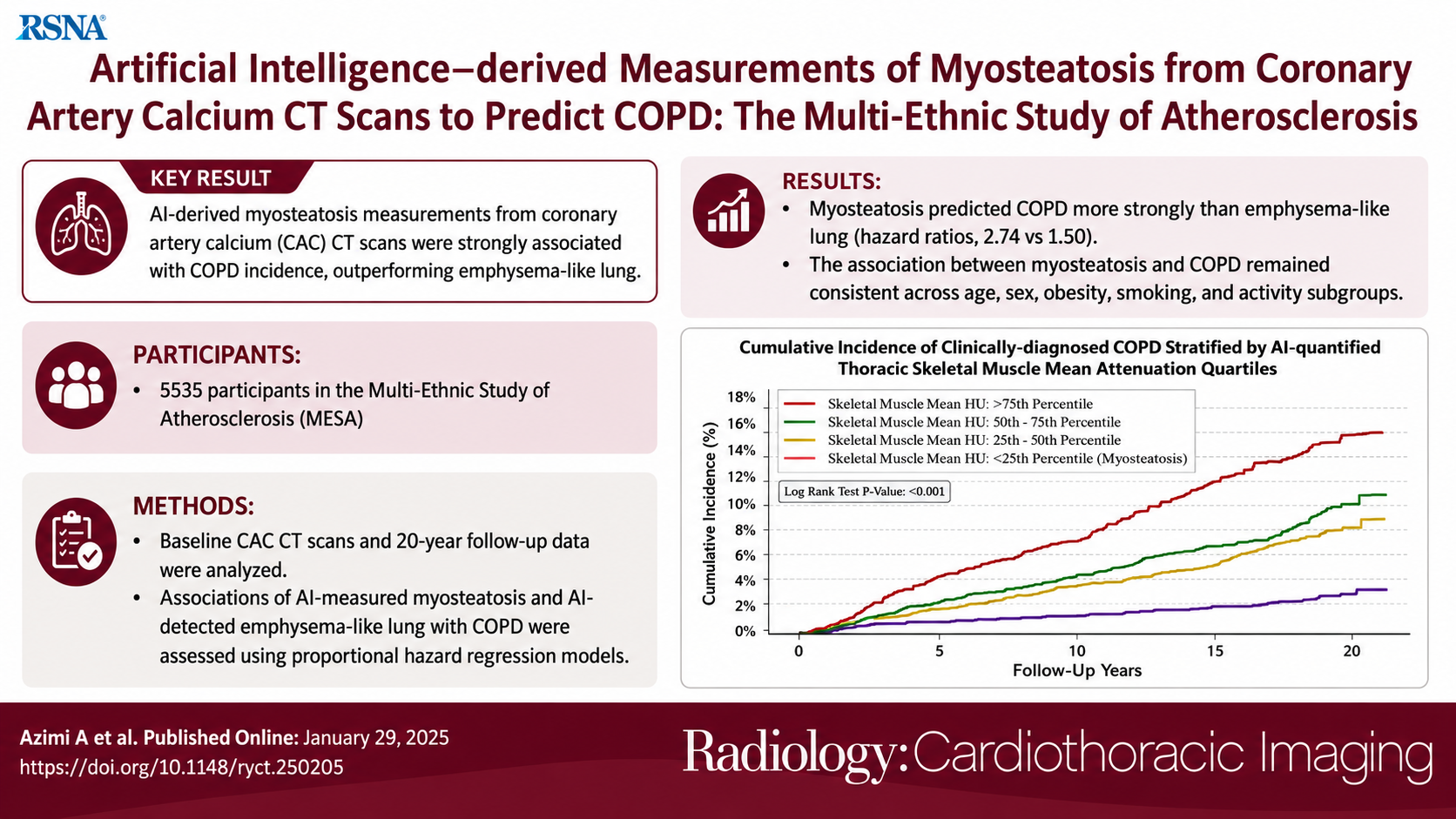
Visual Abstract
20-year MESA analysis finds CT-derived muscle quality predicts COPD more strongly than emphysema-like lung measures
This is exactly where AI can change medicine”
HOUSTON, TX, UNITED STATES, August 7, 2026 /EINPresswire.com/ -- HeartLung.AI today announced that the Radiological Society of North America (RSNA) has featured a major research publication demonstrating the potential of artificial intelligence-derived myosteatosis measurements from coronary artery calcium (CAC) CT scans to predict future chronic obstructive pulmonary disease (COPD). The dedicated RSNA News feature, published August 6, highlights the study's implications for earlier disease detection and AI-enabled opportunistic screening.— Morteza Naghavi, M.D.
The original research, "Artificial Intelligence-derived Measurements of Myosteatosis from Coronary Artery Calcium CT Scans to Predict COPD: The Multi-Ethnic Study of Atherosclerosis," was published in Radiology: Cardiothoracic Imaging, an RSNA journal. The prospective study analyzed baseline CAC CT examinations from 5,535 participants in the Multi-Ethnic Study of Atherosclerosis (MESA) and followed clinical outcomes for approximately 20 years. During follow-up, 396 participants, or 7.1%, were diagnosed with COPD.
Using HeartLung.AI's AI-CVD platform, investigators automatically quantified thoracic skeletal muscle attenuation to identify myosteatosis - a CT marker of fatty infiltration and reduced muscle quality - and compared its predictive value with an AI-derived emphysema-like lung measurement obtained from the same CAC CT examinations. AI-CVD analyzed visible thoracic muscles throughout the scan volume rather than relying on a single manually selected image or region of interest.
Key Findings
The results demonstrated a strong relationship between myosteatosis and subsequent COPD diagnosis. Participants in the lowest quartile of muscle quality had an adjusted 2.74-fold higher risk of developing clinically diagnosed COPD compared with participants in the highest quartile, even after accounting for established factors including age, sex, smoking status, body mass index, race, asthma, physical activity, inflammatory markers, and insulin resistance.
Importantly, AI-measured myosteatosis demonstrated a stronger association with future COPD than the emphysema-like lung measurement derived from the same CAC scans. After multivariable adjustment, the hazard ratio was 2.74 for myosteatosis compared with 1.50 for the emphysema-like measurement. The association with myosteatosis also remained consistent across subgroups defined by age, sex, obesity, smoking history, and physical activity.
These findings suggest that information outside the lungs themselves may provide important insight into future pulmonary disease. Myosteatosis reflects deteriorating muscle quality and has been associated with metabolic dysfunction, inflammation, and adverse cardiovascular outcomes, supporting a broader understanding of COPD as a systemic cardiopulmonary and metabolic disease rather than an isolated disorder of the lungs.
"This is exactly where AI can change medicine," HeartLung.AI Founder and President Morteza Naghavi, MD, told RSNA in its feature on the study. AI enables subtle quantitative findings such as muscle fat infiltration to be measured reproducibly from CT images even when they may not be practical to quantify visually during routine clinical interpretation.
Expanding the Opportunity for Opportunistic Screening
The research highlights a rapidly emerging opportunity in medical imaging: extracting additional clinically meaningful information from CT scans that patients are already receiving.
CAC CT is traditionally performed to assess coronary atherosclerosis and cardiovascular risk. With AI, however, the same imaging dataset may contain quantitative information about multiple organ systems and disease pathways. In this study, a scan obtained for cardiovascular assessment also provided a muscle-quality biomarker associated with COPD diagnosis many years later.
This represents the central promise of AI-enabled opportunistic screening - turning existing medical images into a richer source of preventive health information without requiring a separate imaging examination for every potential condition. HeartLung.AI developed AI-CVD with this approach in mind, using cardiac and chest CT imaging to quantify cardiovascular and noncardiovascular findings that may contribute to a more comprehensive picture of a patient's health.
The RSNA feature is particularly significant because it brings the findings beyond the scientific publication itself and directly to the broader radiology and medical-imaging community. RSNA's coverage focuses on the potential for quantitative AI analysis to identify disease vulnerability that may otherwise remain unrecognized until symptoms or more advanced disease develop.
The investigators emphasized that additional validation is needed before myosteatosis can be established as a clinical COPD biomarker. Future studies are expected to examine the finding in additional populations, evaluate whether changes in muscle quality precede deterioration in pulmonary function, and determine whether interventions that improve muscle quality may influence future COPD risk. The researchers also acknowledged that CAC CT does not completely image the upper lungs, where emphysema may initially develop, which limits direct comparison between the myosteatosis and emphysema-like measurements.
A Multidisciplinary Research Collaboration
The publication reflects collaboration among investigators from HeartLung.AI and leading academic and clinical institutions across the United States and internationally.
The authors are Amir Azimi, MD; Kyle Atlas, MSc; Anthony P. Reeves, PhD; Chenyu Zhang, MSc; Jakob Wasserthal, PhD; Seyed Reza Mirjalili, MD; Thomas Atlas, MD; Claudia I. Henschke, MD, PhD; David F. Yankelevitz, MD; Javier J. Zulueta, MD; Juan P. de-Torres, MD, PhD; Luis M. Seijo, MD; Jeffrey I. Mechanick, MD; Andrea Branch, PhD; Ning Ma, PhD; Rowena Yip, PhD; Wenjun Fan, MD, PhD; Sion K. Roy, MD; Khurram Nasir, MD; Sabee Molloi, PhD; Zahi A. Fayad, PhD; Michael V. McConnell, MD, MSEE; Ioannis A. Kakadiaris, PhD; George S. Abela, MD, MSc; Rozemarijn Vliegenthart, MD, PhD; David J. Maron, MD; Jagat Narula, MD, PhD; Kim A. Williams, Sr, MD; Prediman K. Shah, MD; Matthew J. Budoff, MD; Daniel Levy, MD; Emelia J. Benjamin, MD; Roxana Mehran, MD; Robert A. Kloner, MD, PhD; Nathan D. Wong, PhD; and Morteza Naghavi, MD.
HeartLung.AI authors listed in the publication include Amir Azimi, MD; Kyle Atlas, MSc; Chenyu Zhang, MSc; Seyed Reza Mirjalili, MD; and Morteza Naghavi, MD.
HeartLung.AI authors listed in the publication include Amir Azimi, MD; Kyle Atlas, MSc; Chenyu Zhang, MSc; Seyed Reza Mirjalili, MD; and Morteza Naghavi, MD.
Read the Research and RSNA Feature
RSNA News Feature - https://www.rsna.org/news/2026/august/myosteatosis-as-a-copd-biomarker
Radiology: Cardiothoracic Imaging - https://pubs.rsna.org/doi/10.1148/ryct.250205
About HeartLung.AI
HeartLung.AI is a health-tech company pioneering AI-driven preventive imaging for early detection of cardiovascular disease, lung cancer, COPD, osteoporosis, fatty liver disease, myosteatosis and other cardiometabolic conditions detectable on routine medical imaging. Its FDA-cleared flagship platform, AI-CVD, transforms eligible CT scans into comprehensive preventive health assessments by automatically quantifying coronary artery calcium, aortic and valvular calcification, cardiac chamber size, aorta and pulmonary artery size, epicardial and visceral fat, liver density, lung density, bone mineral density and muscle-fat composition. HeartLung requires no new hardware or local software installation. Hospitals and imaging centers can connect PACS to the HeartLung.AI cloud or manually upload scans and receive AI-generated DICOM and PDF reports.
Marlon Montes
HeartLung Technologies
+1 310-510-6004
email us here
Visit us on social media:
LinkedIn
YouTube
X
Legal Disclaimer:
EIN Presswire provides this news content "as is" without warranty of any kind. We do not accept any responsibility or liability for the accuracy, content, images, videos, licenses, completeness, legality, or reliability of the information contained in this article. If you have any complaints or copyright issues related to this article, kindly contact the author above.
