

New Book Shows How Stalled AI Pilots, Failed Transformations, and Flat Productivity are Taxes Missing from P&L
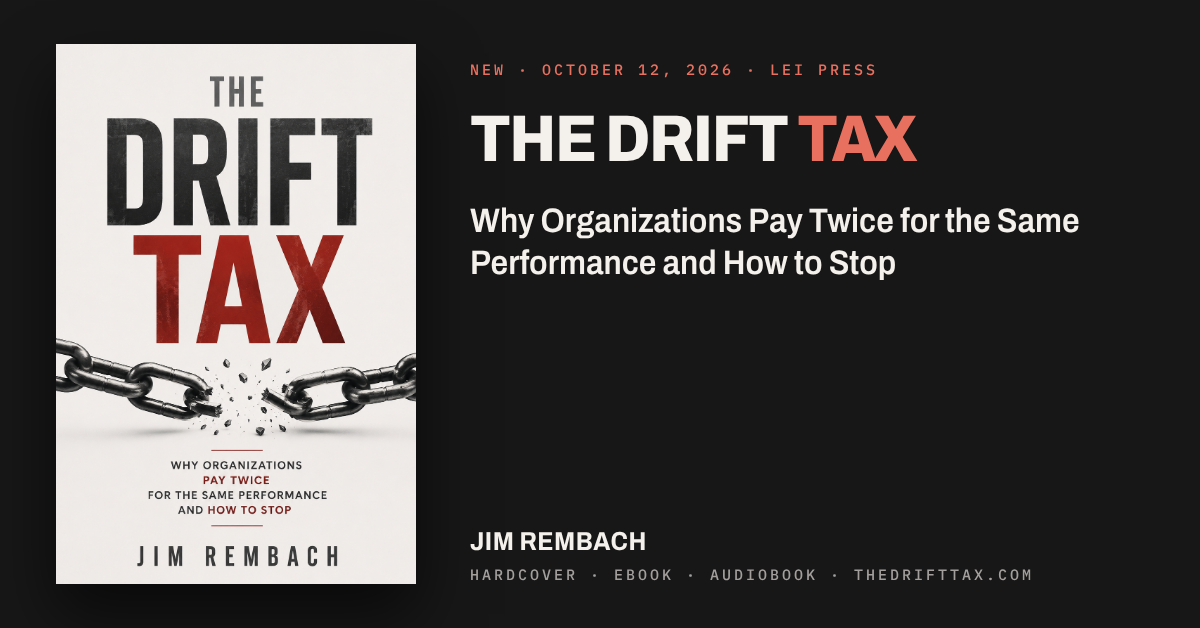
The Drift Tax: Why Organizations Pay Twice for the Same Performance and How to Stop, by Jim Rembach (LEI Press)

Jim Rembach, Executive Director of the Leadership Execution Institute and author of The Drift Tax
"Smart, timely, and immediately useful." Ron Friedman, Ph.D., bestselling author of Superteams, on The Drift Tax
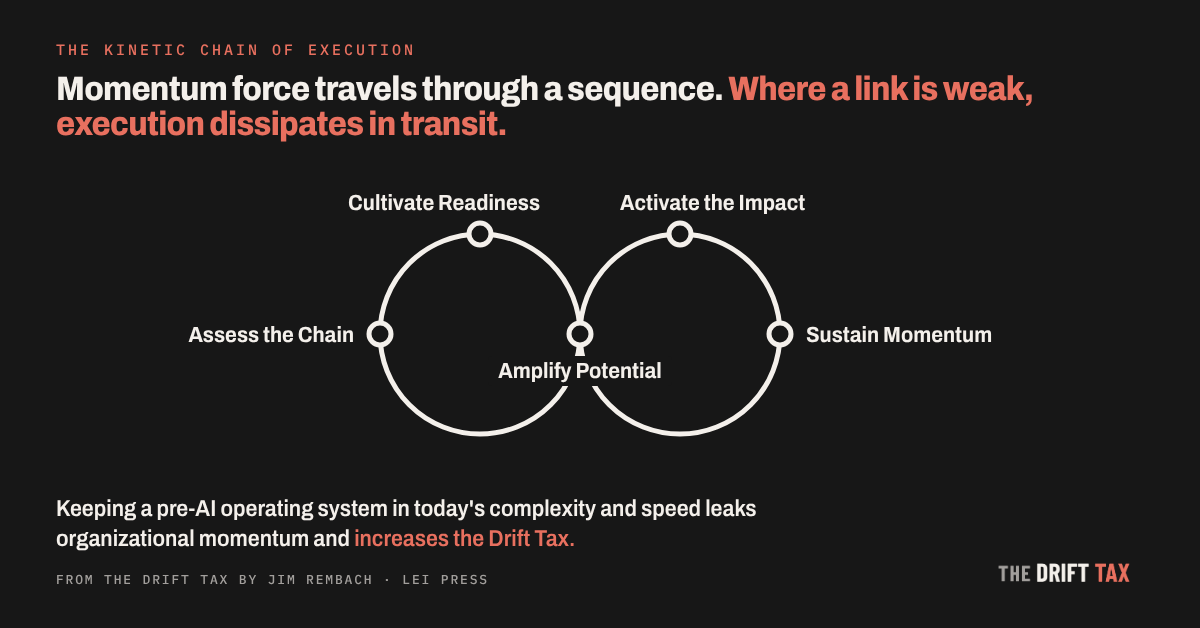
The Kinetic Chain of Execution, from The Drift Tax by Jim Rembach: keeping a pre-AI operating system in today's complexity and speed leaks organizational momentum and increases the Drift Tax
The Drift Tax, by Jim Rembach of the Leadership Execution Institute, shows the most expensive line item missing from every P&L, and how to stop it.
The full title is The Drift Tax: Why Organizations Pay Twice for the Same Performance and How to Stop. Rembach is Executive Director of the Leadership Execution Institute. The book draws on neuroscience, transfer-of-training research, Gallup's manager data, and hundreds of Fast Leader Show interviews to connect findings that have sat beside one another for years without anyone assembling them into one picture. Excerpts, a Drift Tax Diagnostic, and details are at www.thedrifttax.com.
The book opens inside a quarterly business review at a composite company of roughly 1,100 employees. A two-million-dollar AI platform sits at 70 percent of projected adoption. The year's most important initiative has slipped three weeks. One division's engagement score has dropped four points. Three owners present three explanations and three remedies, each with a vendor attached, each approved before lunch. Nobody asks whether the three problems might be one problem, or what the three remedies are quietly re-buying.
Why do a stalled AI pilot, a slipped initiative, and an engagement drop share one cause?
All three are measuring the same thing. In The Drift Tax, the AI shortfall, the slipped timeline, and the engagement drop are one event seen through three departmental dashboards. Underneath them sits the daily behavior of leaders and teams, which decays under ordinary operating pressure when nothing in the environment holds it in place. The platform reports adoption; the behavior layer around it absorbed the change without changing. The timeline slipped in a hundred small moments when a bottleneck was noticed and not escalated. The engagement score, which Gallup's research attributes about 70 percent to the manager, measured a year of skipped conversations and standards enforced on Tuesday and waived on Thursday. Rembach compares the three readings to warning lights on a car. No mechanic confronted with four lit lights orders four unrelated repairs from four specialists. Executive teams do the equivalent every quarter, approving three vendors to replace three bulbs.
What is the Drift Tax?
The Drift Tax is the cumulative cost organizations absorb when behavioral stability decays after investment, forcing the same performance to be paid for again. Compensation is an advance payment on behavior. Judgment, ownership, and consistency are priced into every offer letter and then never examined again. When that behavior drifts, the organization buys it back through consultants, coaching, programs, and relaunches, and books the second purchase as process improvement, as logistics variance, as a culture initiative, as phase two. Paid once at hire, levied again at repair. The second levy is the tax.
Why does finance never see it?
The tax is collected in fragments. Finance absorbs a piece as margin compression. Operations absorbs a piece as productivity variance. HR absorbs a piece as turnover. Strategy absorbs a piece as timelines that slip for reasons no one can name. Each department explains its fragment fluently, in its own vocabulary, to its own committee, and every explanation is locally reasonable. No line on the P&L says what any of it was for. Because everyone pays a fragment, nobody ever sees the total. The book cites McKinsey research in which more than half of CFOs report that transformations now consume the largest share of their time, and roughly seven in ten name organizational buy-in and human behavior, rather than capital or technology, as the barrier to those transformations holding. The most financially disciplined person in the building has a vocabulary for every form of capital risk except the one consuming her calendar.
Why is this not a technology problem?
The Drift Tax does not fault the models. Organizations have poured more than 200 billion dollars into AI, and the binding constraint on returns is almost never the technology. What fails is the human layer around it: the daily decisions, adoptions, escalations, and standards of the people the platform was deployed into. An AI platform at 70 percent of projected adoption is thousands of individual behavioral moments: a supervisor who stopped reinforcing the new workflow in week six, a team that reverted to the old spreadsheet because nobody asked about the new dashboard twice. The organization bolted a machine that requires behavioral consistency onto an operation that never built architecture for it. AI operates at the exact point where behavior is decided, so it scales whatever it finds there. Every organization will end up choosing which behavior its AI reinforces, on purpose or by default.
Why do capable leaders drift?
Drift is biological and structural rather than a character flaw. The human brain runs on roughly twenty watts and automates everything it can; organizations routinely expect that processor to outperform systems consuming thousands of times more energy. Under ordinary pressure, the brain takes the exact capacities leadership premiums are paid for, judgment, patience, and holding a standard when it would be easier not to, offline first. The book gives the forces a name, the FONE Factors: Fear, Overconfidence, Negative Impressions, and Execution Blindness. They do not wait for a crisis. They are running in every organization on a calm Tuesday, and one drifting leader is never one drifting leader, because every standard a leader relaxes becomes permission for someone else.
Why do training, coaching, and dashboards not fix it?
Each one stops one step short of the moment that decides execution. Training ends at the classroom door. Coaching ends when the session ends. Dashboards face backward, recording outcomes of behavior that already happened. Surveys route around the person who owns the standard. Rembach calls that moment the half second, the instant a standard is held or moved, and lays each tool against a leader's actual week to show where it disengages. The Drift Tax is levied in the step nobody's tool takes. This is not an anti-training argument. The tools are not failing at what they were built to do. They stop before the organization needs them most.
What does the book give the reader instead of advice?
Instruments. The book never estimates a total, and every cost it describes is traced to a payment the organization already approved. Each chapter closes with one: three questions to ask in any compensation discussion, a test for whether several "unrelated" problems share one upstream cause, four signals that a team has stopped compounding, a probe that dates a resignation months before it was typed, an audit that sorts people spending into first purchases and repurchases, a five-question ownership test for the layer every plan depends on, a map of where each investment stops touching a leader's day, and six properties any solution must have to hold behavior rather than describe it. The book also includes the Drift Tax Diagnostic: ten statements about how an organization runs on an ordinary Tuesday, scored as an Architecture Score that shows how much of its stability is held by design rather than by effort.
Who wrote The Drift Tax?
Rembach spent three decades inside complex operations, beginning on the frontline and including seventeen years at Customer Relationship Metrics converting real-time execution data into strategy. That work put him in the same room twice, once when an investment was approved and again when the results faded. As host of the Fast Leader Show he has interviewed hundreds of the world's most influential management thinkers, and one question kept surfacing: why does performance fade after every investment meant to improve it. The book is his answer. The financial lens came from his kitchen table and a thirty-three-year marriage to a CPA.
"Your AI problem is a drift problem. It was always going to be," said Jim Rembach, Executive Director of the Leadership Execution Institute and author of The Drift Tax. "You bolted a machine that requires behavioral consistency onto an organization that has never had architecture for behavioral consistency, and the machine is faithfully reporting the absence. Nobody fails. Everybody pays. This is not an HR problem. It is a P&L problem wearing an HR costume."
"Building a high-performing team is hard. Keeping it high-performing is even harder," said Ron Friedman, Ph.D., bestselling author of Superteams and The Best Place to Work. "In The Drift Tax, Jim Rembach shows leaders how to create an environment that reinforces the right behaviors day after day in ways that promote sustained excellence. Smart, timely, and immediately useful."
The Drift Tax: Why Organizations Pay Twice for the Same Performance and How to Stop is available now in hardcover, ebook, and audiobook through Amazon and major retailers. Readers can take the Drift Tax Diagnostic and receive an Exposure Report before opening Chapter 1. Excerpts, details, and the diagnostic are at www.thedrifttax.com.
About The Drift Tax
The Drift Tax: Why Organizations Pay Twice for the Same Performance and How to Stop, by Jim Rembach, is published by LEI Press and released October 12, 2026, in hardcover (ISBN 979-8-90589-141-0), ebook (ISBN 979-8-90589-139-7), and audiobook (ISBN 979-8-90589-142-7). The book traces how the capability an organization funds at hire decays under ordinary operating pressure, how that decay converts into margin compression, productivity variance, turnover, and stalled initiatives, and how the same performance ends up purchased a second time. It includes the Drift Tax Diagnostic, ten statements about how an organization runs on an ordinary Tuesday, scored as an Architecture Score. www.thedrifttax.com
About Jim Rembach
Jim Rembach is the Executive Director of the Leadership Execution Institute and the President of Execution Architects, where he helps senior leaders protect the performance their organizations have already paid for. He is the author of The Drift Tax and the host of the Fast Leader Show, where he has interviewed hundreds of the world's most influential management thinkers. A certified EQ-i 2.0 practitioner, certified in Mental Performance Mastery, and a certified baseball pitching coach, he spent three decades inside complex operations before turning to the question this book answers. He lives in Greensboro, North Carolina.
About LEI Press and the Leadership Execution Institute
LEI Press is the publishing division of the Leadership Execution Institute, an independent research organization studying leadership behavior, behavioral drift, and culture-calibrated execution systems in modern organizations. Its work examines why performance decays after investment and what makes it hold. The institute's research briefs, reports, and publications are available at leadershipexecutioninstitute.org.
Review copies, interviews, and excerpts are available on request.
Emma Allen
Leadership Execution Institute
+1 336-202-1032
Visit us on social media:
LinkedIn
YouTube
Legal Disclaimer:
EIN Presswire provides this news content "as is" without warranty of any kind. We do not accept any responsibility or liability for the accuracy, content, images, videos, licenses, completeness, legality, or reliability of the information contained in this article. If you have any complaints or copyright issues related to this article, kindly contact the author above.
